Saturday, March 21, 2009

Speak


Speak, by Laurie Halse Anderson


From her first moment at Merryweather High, Melinda Sordino knows she's an outcast. She busted an end-of-summer party by calling the cops - a major infraction in high school society - so her old friends won't talk to her, and people she doesn't know glare at her. She retreats into her head, where the lies and hypocrises of high school stand in stark relief to her own silence, making her all the more mute. But it's not so comfortable in her head, either - there's something banging around in there that she doesn't want to think about. Try as she might to avoid it, it won't go away, until there is a painful confrontation. Once that happens, she can't be silent - she must speak the truth.


This book has been on my periphery for awhile, but it was still surprising to me that it has a tenth anniversary edition already - ten years ago this should have been exactly the kind of book I was reading. Maybe if I had, it would have had a bigger impact on me, like The Luckiest Girl in the World, which is all kinds of melodramatic and over the top but remains one of my favorite "serious topic" books. Reading Speak for the first time as an adult, long since gotten over any high school scars, there is less of an emotional impact, less forgiveness for mood over technique. In less obtuse terms, I just didn't buy into the plot. Back in the day, that wouldn't have been a problem - books that I connected with as a teen were put into continuous rotation regardless of minor flaws. But reading it for the first time, it niggles at me, and distracts from my enjoyment of it. And there is a lot to be enjoyed from Speak; it is a good book, an excellent book for young teens especially. Speak is about Melinda, and from a character development standpoint, it's an amazing piece of work. I truly believed in (almost) all the characters, as they were written very realistically, and the internal viewpoint style of the book lends itself well to a thoughtful look at Melinda's feelings and struggles. Having a less than perfect memory of my own high school years, I can't argue with the author's depiction here - although from my own perspective, few have managed puberty with the grace and goodwill that I demonstrated time and again in the face of everlasting ridiculousness on the part of other people.

While I am willing to believe in the character and life of Melinda, I am not willing to suspend all my disbelief (and a little bit of disappointment) in the plot she must navigate. It doesn't take a detective to read between the lines of the front cover flap, but in case you are easily startled the rest of this review involves a major ***SPOILER***SPOILER***SPOILER*** (although to be fair, it's only a spoiler if you've been under a rock since your early letter-learning days). The book begins at the beginning of school, maybe a few weeks after Melinda called the cops on a teenage party where she was raped, pissing off all her friends, and this is where my imagination begins to stretch. Since the book never covers this time period, we are left wondering why not a single one of her friends asked her why she called. I find it hard to believe that not one of her friends from who knows how long didn't stick by her, at least until Melinda had the opportunity to drive them away as she does someone else later in the book. It made me question just how valuable these friends are in the first place, if they can't forgive one summer faux pas against the years they knew Melinda. And yes, Anderson does try to make even older readers understand the depths of betrayal of the cop-calling (one student's sibling lost their job, or some such thing) but I think the more natural reaction isn't the flat-out hate that Melinda has to deal with, but more of an insidious lack of trust. I feel like the reactions of the other kids are so overblown that it becomes cartoonish, while a more realistic rendering would have been more powerful - trying to fight outright hate is (true story) easier than fighting smoke, the frustration of trying to prove the negative, that you aren't untrustworthy. The matter of Melinda's age also bugged me - it's such a small detail, but she's a full year younger than she should be as a freshman, which made her younger at the time of the rape, and the moment of reveal is done such that I feel like it's just to manipulate the reader, trying to add shock value, a look-how-awful-because-so-young! moment. The mere fact of the rape is appalling by itself, and even though I am sure Anderson didn't intend the age thing to come off the way it did, well, it did to me.

And while we're on the subject of unnecessary overexaggeration, I would like to get the matter of the rapist off my chest. WHY IS HE PURE EVIL? I mean, yes, of course, he is terrible, because anyone who does that to a girl is terrible, but why is he so dumb as to attempt to do it again after she accuses him and her friends don't even believe her? It is nice to prove Melinda's strength and healing after the course of the book, but how insane was that whole scene? To be fair, I was on the edge of my seat biting my nails just as much as the next person, but even while I was terrified for Melinda, I was thinking, "Oh, come on." Part of the reason for the book's endurance is the realistic treatment of teenagers and rape, and all of a sudden there is a too-perfect opportunity for Melinda to change her future the way she can't change her past, and I just don't buy it. I can't help picturing people who have their own struggles to conquer, reading this book and finding hope, but then being like, "Well, since I didn't get cornered by my rapist again and fight him and win and everyone believes me this time, it's not a good ending." Not only are there other ways to prove your strength besides ass-kicking your former rapist, those are much more common. I guess, in the long run, I would have preferred a book that took the hard way out, the way without a tidy bow, the way that has to accept that even without the opportunity to expose your rapist for the scum he is and prove your own strength and non-victimness, you can live without fear or shame.

So give this to every young girl you know, but give it to them before they grow up and become too cynical to read this books for all of its gifts, and none of its flaws. In short, mamas, don't let your babies grow up to be cowboys.

Wednesday, March 4, 2009

The Turn of the Screw


The Turn of the Screw, by Henry James


The story starts with friends sharing ghost stories 'round the fire on Christmas Eve. One of the guests tells about a governess at a country house plagued by supernatural visitors. Only the young governess can see the ghosts; only she suspects that the previous governess and her lover are controlling the two orphaned children for some evil purpose. The household staff don't know what she's talking about, the children are evasive when questioned, and the master of the house is absent. Why does the young girl claim not to see a perfectly visible woman standing on the far side of the lake? Are the children being deceptive, or is the governess being paranoid?


I hated this book. Novella, story, whatever. I am relying on my (not always reliable) memory because if I never read another word of Turn of the Screw, it will be too soon. I have to work hard just to erase the memory that I do have of this book. It was, in a word, agony to get through. I cannot say this enough: I hated this book. Hate, hated, will hate. The story is not simple: a tale within a tale. The book, like Shakespeare's Taming of the Shrew, begins with a group of people telling stories, in this case, ghost stories. Like Shakespeare, once we are thrust into the main meat of the book, we never return to the original storyteller and listeners. Had I been at that gathering, I would have a few choice words for the storyteller, not least of which would be a scathing indictment of the company they keep and their opinion in the "scariness" of their chosen tale.

The main character (I dare not call her "heroine") is the governess, sent to watch over two young children in the countryside, whose uncle and guardian can't muster up the energy to care for them himself, or to actually find a responsible caretaker for them. Instead, he settles on our erstwhile narrator, who begins as she means to go on: maudlinly, irrationally, and with the certainty granted to both lunatics and self-declared martyrs. All of which she is. A worse governess I cannot imagine. Were it only the governess whose character I despised, I might think that Henry James is actually a genius, able to write good stories without the benefit of the reader liking the main character. Not so. I hate the governess, the children, the housekeeper, the ghosts, the uncle, everyone. I hate the drary monotony of the story, and the absurdity of the plot and actions. It's like the stupid plotline, where the only way to get to the climax is to have every person behave as though they had a head injury, or a script. There is no reason (or at least we're privy to none) as to why anyone would act the ways they do. The sheer irresponsibilty of the governess begs the question of why she wasn't locked up after these events. The mere knowledge that this person was able to obtain work, and work as a governess after this strained and broke the limits of my patience and imagination. The whole situation was so crazy that I didn't even care whether or not the ghosts existed - the mere continuance of the governess in her role, and the fact that no one removed her to a padded call was such an annoyance that the whole ridiculous demonic children side story was only insult added to injury. The governess, upon deciding that the children are under the influence of their former servants, alternates between coddling them and shrieking at them like a priest in the grips of an exorcism. Then (and I don't care if this is a spoiler) she kills one of them. Or at least, that is what I like to imagine, since that would atone in some small part for my having read all the way through to the end.

I repeat: how, how, could she have gotten another job as governess after this? Who would have hired her?! It boggles the mind. The one bright spot is that at least my copy has this awesome 70s cover on it, which, while still producing feelings of appalled fascination, also provides unintentional hilarity to lighten the mood.

The Season


The Season, by Sarah MacLean


Seventeen year old Lady Alexandra is strong-willed and sharp-tongued -- in a house full of older brothers and their friends, she had to learn to hold her own. Not the best makings for an aristocratic lady in Regency London. Yet her mother still dreams of marrying Alex off to someone safe, respectable, and wealthy. But between ball gown fittings, dances, and dinner parties, Alex, along with her two best friends, Ella and Vivi, manages to get herself into what may be her biggest scrape yet.

When the Earl of Blackmoor is mysteriously killed, Alex decides to help his son, the brooding and devilishly handsome Gavin, uncover the truth. But will Alex's heart be stolen in the process? In an adventure brimming with espionage, murder, and other clandestine affairs, who could possibly have time to worry about finding a husband? Romance abounds as this year's season begins!


This is a relatively harmless little book. It's told from the point of view of one who is poised on the cusp (at the start of the book) of entering society. There were, of course, anachronisms in the book, it's hard to find a regency novel without them, these days. It's a delicate balance between admirable heroine and realism of the times. Certainly I doubt that any young lady went about "breaking into" houses, or even expressed half of the sentiments that Alex does, without much disapprobation. The trend of giving heroines nicknames which are boys names has always irritated me, as well. To me it seems to say, "she's feminine, because look, she's got a girl's name, but girls aren't as cool as boys, so we'll pretend that she's one of the guys with her nickname." I have the feeling this is a long suppressed feeling, which has only now had the opportunity to air itself. Perhaps if the plot or characters better satisfied me, I wouldn't take so much offense at the matter of her nickname.

The plot, such as it is (and my general malcontent may be attributed to a possible desire for a mystery/romance rather than a romance/mystery, as was the case) is not ill-done, giving us suspects who are so obviously guilty they have to be guilty, as well as those so obviously guilty, they must be working on the side of good. One of my peeves was that Alex was never really wrong in any of her assumptions, and didn't cause more confusion and misdirection than she solved, as I would generally expect of a seventeen year old girl in regency England. Not that I assume that all seventeen year old girls are stupid - although given my own behavior at seventeen that opinion wouldn't be baseless - but her circumstances don't inspire confidence that she will have magically attained clarity of insight into murder.

Well, it certainly doesn't sound as if I liked the book at all - and that's only partially true. It wasn't offensive to me, as some books have been. I wouldn't mind re-reading it, but only for those sweet sections which describe first, true love (and in these types of societies, the only one you get). The author seems to be setting the three girls (more on that later) up for a series of books, and I will probably read the others in the series as well, but I would wait to check them out first before purchasing, next time. The three girl friends are one of the most refreshing parts of the book. Too often the heroine is cut off from good, female friendship and advice, and the friends in this book more than adequately perform their duties in that regard. They are close without being confining, supportive without being foils. They are neither perfect nor merely a backdrop for Alex's own exploits. I wouldn't mind reading ten books with faults worse than this one, as long as they contained good friendships. So, could be better, could be worse, good if you're in the mood for a short, sweet chaste romance, with some adventure and balls thrown in.

And I mean "balls" in the "gala" sense, not the "frank 'n' beans" sense. Get your minds out of the gutter.


Monday, March 2, 2009

A Garden in the Rain


A Garden in the Rain, by Lynn Kurland


After her fiance, Bentley Douglas Taylor III, dumps her, then fires her, Madelyn Phillips attempts to salvage what she can from the wreckage of her life by going ahead with her planned trip to Scotland sans Bentley, only to find him twit waiting for her there in a misbegotten attempt to convince her to return to him. While trying to ditch Bentley, Madelyn bumps into Patrick MacLeod, the lethally handsome Scotsman who earlier almost ran her off the road. At that moment, Madelyn intuitively realizes that Patrick is her one true love, but she hesitates to communicate this inexplicable idea to him since she's puzzled by it herself. Even if Madelyn reawakens a long dormant sense of desire in him, Patrick knows telling her the truth about who he really is will destroy any chance of a relationship.


I suppose I should begin by saying that I was not best pleased by this book. I had high expectations, admittedly, since the description was so promising ("Ditched by her fiance!" "Taking her honeymoon trip alone!" "Love at first sight, but retaining at least a minimal sense of rationality!") but it began to fizzle about as soon as Madelyn's ex-fiance stepped onto the scene. His presence in the book is almost a mystery - he is so buffoonish, so cartoonishly old-fashioned evil, that while his presence serves to vex our heroine, her sufferance of him vexes me. True, she doesn't like him, doesn't like to be around him, but her acceptance that he is merely a jerk, and not, say, completely out of his mind insane, is bewildering. And he is insane. His reasons for sticking to her like a burr are so mwa-ha-ha-ha batshit crazy that he clearly wandered out of some gothic romance for impressionable young girls of the 1800s, and has but poor luck in making sufficiently convoluted and apalling schemes which fit the twenty-first century. Nowadays we are all about internet scams and drive-bys, young man.


While Bentley should have been living in the 1800s, Patrick MacLeod, hero of the piece, supposedly was. "Was" being the operative word. Like any good transplant from 1795, Patrick practices swordfighting and mooning about over old battlefields in his spare time. One of the best sequences in the book happens as Patrick and Madelyn first get a good look at each other over Culloden - each is struck by a nameless feeling, natch, and Madelyn, overcome, shouts over to him that they're soulmates. This intentional bit of levity was unfortunately, suceeded by a very dull and lengthy middle section - all about their various encounters, and their various encounters with Bentley (I will be fair - this is where we were introduced to Bentley's magnificently thought-out plot, which mocks, deservedly, any reasonable person for reading so far), wherein Patrick buys her lots of clothes and a new violin, she wonders, does he or doesn't he?, he mourns, I can't!, but then they can, but then they can't, secrets, love, angst, etc., etc., until finally, finally, Madelyn falls into one of those mysterious spots that were so oddly marked for her on a map of the forest. And thus begins our descent into hell.


This whole half of the book was like, whoa. Madelyn (and I hope this won't spoil it too much for you) gets peed on. Peed on. Repeatedly, over a course of about four weeks. Four weeks! As you can tell, I am still overcome by the memory. Four weeks! In a little bitty cage, learning gaelic from a conveniently placed piper. Meanwhile, our erstwhile hero gets to dress up with a sword and beat the shit out of everyone he meets (I exaggerate). There is, apparently, no humilation our dear author will not subject Madelyn too, which just makes me contrarily, no doubt, hate Madelyn all the more. This woman is so beaten down by recent events, that even were I to accept the ridiculous premise, the fact that she has no money, no clothes, no apartment, no passport, nothing of her own, literally, that she is completely dependent (as Blanche Dubois would say) on the kindness of others, would make me cry foul at her romance with Patrick. It doesn't feel like love so much as dependency, and a dependency which is prevented at every turn from becoming anything resembling independency. Madelyn may be the most resiliant person in the world, who has the will and ability to overcome all kinds of obstacles. But we're never given a chance to find out. Her every rescue, from perils both Bentley and otherwise, is performed by Patrick, which makes for a fairly one-sided match. That, I suppose, is my biggest problem with the book. The whole thing left a bad taste in my mouth, and if in the future I feel the need for a time-traveling romance I shall fall back on Outlander, whose heroine has both common sense and a sense of humor.


NB: As a special bonus, I leave you with these words, which the title frequently and amusingly brought to mind:

Someone left the cake out in the rain
I don't think that I can take it
Cause it took so long to make it
And I'll never have that recipe again!
Oh no!

Wednesday, February 25, 2009

The Sevenwaters Trilogy


Daughter of the Forest, by Juliet Marillier


As the only daughter and youngest child of Lord Colum of Sevenwaters, Sorcha grows up protected and pampered by her six older brothers. When a sorceress's evil magic ensorcels Colum's sons, transforming them into swans, only Sorcha's efforts can break the curse. A re-telling of the old fairy tale, set in Ireland as the older beliefs are beginning to be overtaken by christianity.


I have to be honest here, this book is horrifying. This book has so many terrible things happen to the people that we're supposed to like, it was a never-ending strain on my nerves, even though I know the old fairy tale well, and I should have been able to relax about the fate of our protagonist, Sorcha. Initally, I was unable to concentrate on the story because of my preoccupation with our heroine's name. It was a little too close to Sorsha, from the movie Willow, for comfort. All I could think of was that scene when Mad Martigan gets hit with that love potion, and they get into an argument, and she's yelling, "'I dwell in darkness without you' and it went away?" I really enjoy that movie, not least because of an early review of it, regarding Jean Marsh as an effective tool to force small children to eat their vegetables. (cf. If You Ask Me by "Libby Gelman-Waxner"). But soon enough, the ominous suggestions in the beginning are fulfilled, and Sorcha is called upon to save her brother through hard work, pain, and silence. I was already sucked into story by the time something horrible in particular (now I sound like I read too much Cold Comfort Farm) about a third of the way in, which was completely unexpected (by me) and therefore doubly shocking and, uh impactive, for lack of a better word. It was at that point that I realized that despite my foreknowledge of the ending, there could certainly be a lot of despair and horror before we reach that point, and that even once that point is reached, there is no guarantee that you'll get warm fuzzy feelings after turning the last page. And that realization makes the book more powerful, because you begin to experience events with the characters, and therefore know just how hard the task set before Sorcha is. The ending, which does end, as much as possible, happily (there are further revelations which serve to further depress the spirit, but they don't affect Sorcha directly, and at that point, I was willing to take victories where they lay) feels all the more joyful because of the sadness that preceded it. This is an excellently written book, a graceful and unique re-telling of the Seven Swans, one which may not be out of place among the so-called original Grimm's Fairy Tales, a la the Little Mermaid and her sea foam demise. It is harrowing, but the ability to make one scared for a character, even when you supposedly know the end to her story, is the mark of a good writer.


'Son of the Shadows (Book 2)

Liadan of Sevenwaters is the child of Iubdan and Sorcha (whose story was told in Daughter of the Forest) and she is granted the power to hear and see what others cannot. She is a healer of mind, body and spirit. It is Liadan's gift of healing that brings about a meeting with a mercenary considered to be the enemy of her family. Liadan names this man without a name or history "Bran" and soon realizes that the information she has been told about him (and the world in general) is not what it appears to be.


Okay, so, I was very excited about this one, because I read the first in the series and fell in love with the characters and the story. This one was, well, a bit of a let down. I think that's partly by virtue of the strength of the first entry in the series, and also partly because after the first one, I became somewhat inured to the almost ridiculously awful experiences that Marillier likes to puts her characters through (in this series at least - those in Wildwood Dancing got off easier). This was a good middle entry, although I personally didn't find the heroine, Liadan, as sympathetic as Sorcha. Liadan is a very different person than Sorcha, one who is not merely buffeted by the winds of fate and destiny (as is made very clear by her refusal to listen to the warnings of the Old Folk in the forest). SotS certainly sets things up for the third book, in more ways than one, set as it is about eighteen years after Daughter of the Forest and eighteen years before Child of the Prophecy. The tone of this volume is very different from Daughter of the Forest, possibly because it's not based on legend, possibly because it is more focused on very earthly problems, rather than the sorcerous and magical problems of the other books. It is well-written, but doesn't create the same sense of urgency and connection that DotF does. With the wisdom granted in hindsight, I would say that this is my least favorite installation in the Sevenwaters Trilogy et al. (although still not bad in and of itself). There are some very good sequences, such as when Liadan is kidnapped and asked to save a mercenary's life, and also an exciting escape involving fairly high stakes. These are only sequences though, and not the same as the continued strain of DotF.


Child of the Prophecy (Book 3)


The saga of the guardians of the forest at Sevenwaters takes up the story of Fainne, daughter of the former Druid Ciaran and the lost Niamh. Raised in the ways of magic, Fainne plans to become a solitary sorcerer like her father, but fate intervenes in the form of her grandmother, Oonagh, a sorceress with a penchant for cruelty and a desire to put an end to everything the Sevenwaters folks stand for. A prophecy tells of a way to preserve the old magic, and Lady Oonagh is willing to trick her granddaughter and torture her own son to break it. Though Fainne is forced to bow to her grandmother's will, the love of her family and her own strong ethics help her remember her true nature, as she learns about herself, her powers of sorcery and the part she plays in a prophecy that has tested three generations of women.


This is a strong conclusion to the trilogy, neither my least nor best liked. The plot concerns the journey of Fainne, who travels from Kerry to Ulster on the orders of her father and grandmother (although each has different reasons for so ordering). The Lady Oonagh, back from the first book, pops up, although she doesn't have the same air of menace that she did in DotF. Although I was tempted to be frustrated with Fainne by her lack of self-confidence and willingness to obey her grandmother's dictates, there are good reasons for her behavior and mindset, as Marillier adequately explains her circumstances so that her actions are completely reasonable for someone in her position. The resolution of the trilogy fell a little flat to me, because after all this build up, after all the tension between Fainne and Oonagh, after the big battle at the end for the island, it seemed a little. . . easy . . . for them to defeat the threatening evil. I was, perhaps through no fault of the author's, sucked into believing that Fainne's decision would directly impact the outcome of the battle, influence and direct the flow of it, and that didn't happen - the battle was fought and decided without her interference at all, and her purpose in the larger scheme of things is revealed only after the sorceress is well defeated, too. I did really like the evolution of the love story here, I found both Fainne and her sweetheart to be delightful in their mutual wishes to protect the other (I am kind of sucker for that). A bittersweet ending to the saga, but an appropriate one, and satisfying in a way that DotF couldn't be, by tying up sundry loose ends.


Heir to Sevenwaters (Bonus Extra Book)

Clodagh, the third daughter of the lord of Sevenwaters, is the practical one who keeps things running while her aging mother awaits the birth of a male heir. At her sister's wedding, she meets rude, closed-off Cathal, one of her cousin Johnny's personal guards. Shortly after, when the Fair Folk replace the newborn heir with a changeling creature, Clodagh and Cathal put their lives and sanity on the line to rescue the child.


This is my second favorite of the bunch. Here, Marillier returns to a more patterned story, this one modeled after various changeling and fairy folk-related tales. The plot is fairly straightforward (not something which can be said for others in the series), wherein Clodagh, a normal, unmagical girl, is thrust into the position of having to traverse the Otherworld to bargain with Mac Dara, the new (and quite villanous) Lord of the Fey. He is so bad, in fact, that one almost wishes he had a moustache to twirl as he discusses his dark deeds. The tone of Heir is much lighter than that of the previous three, which was a relief since I read them all in a row, and after several days of this particular Series of Unfortunate Events I needed some good clean romance and fantasy without all the doom and gloom attached. There is, naturally, still some doom and gloom (otherwise it just wouldn't be a Sevenwaters book), but it is restricted to warnings for the future rather than present misfortunes. Marillier really evokes the world of her characters, and never is it more apparent than here, where the changing landscape and the attendant pitfalls play a big part in the plot.

ETA: I was re-reading the books and re-read this entry to see what I used to think about them, and I realized that I didn't remember the fourth book at all, except for that twig-baby. How creepy was that thing?! And it like, moved and cried like a baby, too, didn't it? Can you imagine a heap of twigs crying like a baby and waving little stubby branches around? Because I can, and it is horrifying.

Just a heads-up.


Throughout each book, there are common elements and themes - for our heroines, they may take the message away that love suceeds in the end (although those poor souls who aren't the main characters may not trust so easily to this). There is, oddly enough, in each story the counterpoint of a young (usually) man who also genuinely loves the heroine, and in some cases puts himself through extreme privation in order to be with her. In any other book, this would make him the hero, but here they have naught but disappointment and/or death. The presence of these characters serves to remind us that love is a tricky thing, and cannot be forced but only freely given. It's a nice touch, and meshes well with Marillier's desire to bring down even the most well-earned happy endings. Another theme is that of the frailty of life, and way of life. In later books especially, is the idea that sooner or later (sooner) the old ways and beings will pass from this earth. It may be appropriate to the time period (and Sevenwaters is far from the only book to touch on this topic, ever since Peter Pan told us not believing in fairies killed them; Veil of Gold echoes this feeling of widening separation between reality and story) but it lessens the importance of the characters' actions. All in all, a wonderful series.

Tuesday, February 24, 2009

Billy Budd


Billy Budd, by Herman Melville


Aboard the warship Bellipotent, the young orphan Billy Budd was called the handsome sailor. Billy was tall, athletic, nobel looking; he was friendly, innocent, helpful and ever-cheerful. He was a fierce fighter and a loyal friend. All the men and officers liked him...

All but one: Master-at-Arms Claggart. Envious, petty Claggart plotted to make Billy's life miserable. But when a fear of mutinies swept through the fleet, Claggart realized he could do more than just torment the Handsome Sailor...He could frame Billy Budd for treason...


Herman, Herman, Herman. What are we going to do with you? I'll be honest here, I am not Melville's biggest fan, unless by "fan" you mean "someone who badmouths his writing style every chance she gets and constantly bemoans the wasted hours she spent struggling through Moby Dick, which is, let's face, pretty much the textbook example on why ignorance is bliss". Let's just say I was happier not knowing every minute detail of how, say, the hump back differs from the razor back from the sulphur bottom, and on and on, until I have lost not only the thread of the plot, but my sanity as well. However, now let me speak of Billy Budd, handsome sailor and all-around pretty boy.


This book is certainly mellifluous - if nothing else, Melville does know how to string a pretty group of words together, often at the loss of any sense, but still. The introduction to my book states that towards the end, Melville become increasinly upset at the inability of readers to understand him. I can only say that those readers have my utmost sympathies, because Melville seems to have written Billy Budd in some maniacal fit of pique, with an outdated thesaurus, carefully running on all sentences and obscuring all rational ideas with bizarre word choices and startling similes. Here's a sample:


From his chief's employing him as an implicit tool in laying little traps for the worriment of the foretopman - for it was from the master-at-arms that the petty persecutions heretofore adverted to had proceeded - the corporal, having naturally enough concluded that his master could have no love for the sailor, made it his business, faithful understrapper that he was, to foment the ill blood by perverting to his chief certain innocent frolics of the good-natured foretopman, besides inventing for his mouth sundry contumelious epithets he claimed to have overheard him let fall.


So, it's not quite enough to be mad babbling, but it is enough to make you wish for Melville in person, so you could shake him and scream, "Get to the point!" The story itself is pretty straightforward: Billy the Handsome (there is a fair amount of gay subtext in this novel, not the least of which appears to stem from Claggart's jealousy of Billy for being too. . . pretty. For real.) is accused of mutiny by the master-at-arms. Billy's method of dealing with the accusation is about as sensible as Melville's writing style, i.e., garaunteed to end in misery. There are good themes hidden in the story, of the battle between the letter of the law versus the spirit of the law. Compounding Billy's dire situation, and my headache, Melville treats us to an exhaustive (not extensive, perhaps, but certainly exhausting) treatise on the circumstances surrounding the plot - a period of dangerous unrest and mutiny in the British Navy. The atmosphere lends itself to urgency, while the players are left in the end to the worst fate of all: living with their own actions. Thought-provoking, but skimming will do just fine.

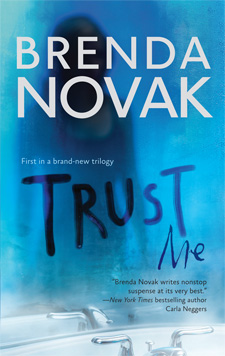
Trust Me

Trust Me, by Brenda Novak

Attacked four years ago at home by rapist and murderer Oliver Burke, Skye defended herself and put him behind bars. Inspired by her own struggle, Skye began the Last Stand—an organization focused on helping survivors and teaching self-defense. She is also wrestling with an attraction to the detective from her case, David Willis. When Burke cuts a deal, the fiend is out on the street, eager for revenge on Skye—who has been the focus of his continued obsession.
This isn't a bad book by any means - simply not a stellar one. The premise is, indeed, quite creepy, even if parts of the plot stretch the imagination at times. Skye is working on losing the fear that plagues every moment, something which has suddenly become much harder with the news that her attempted rapist and suspected murderer is being let out of prison early. No sooner does she get the bad news than disturbing events begin taking place. Skye is a good protagonist, one who puts her money where her mouth is, so to speak. Her actions, while they may initially appear extreme, aren't so unreasonable if you consider the trauma that she's been through - one of the most effective tools that Novak uses is the chilling possibility of this ever happening in real life. Novak is fairly skillful at presenting the helplessness and terror that arise from knowledge of your own vulnerability to stronger outside forces. Skye's struggle with her feelings for the detective are also relatable - rather than pine away for what he refuses to let happen, she makes the decision to move on. For the sake of my own peace of mind, I am ignoring the awful plot device which has the power to completely alter Skye's character, to the extent that within two days she suddenly gains the power to forgive and forget, despite three years of nonstop dwelling. The quick (and somewhat alarmingly cheery) wrap up at the end made my head spin, and yet for all that I wouldn't mind reading another by her.

Monday, February 23, 2009

The Hollow Kingdom Trilogy

The Hollow Kingdom (Book I), by Clare Dunkle

Kate and her younger sister, Emily, are orphans, sent to live with great aunts at remote and mysterious Hallow Hill. Hugh Roberts, their guardian, is a surly and somewhat sinister cousin. One afternoon, the girls come upon some strange people and an abnormally huge cat in a clearing. One of these folk, Marak, is a goblin king. He needs Kate to be his human bride, for goblins may not marry their own kind. When Emily disappears, Kate assumes that he is responsible and agrees to marry him in exchange for her sister's freedom.
This is a pretty fascinating book - this is a lot darker than normal fairy tales or romances. The underground kingdom, over which Marak rules, is not forgiving to new brides. The first section of the book is taken up with Marak's pursuit of Kate, and with the introduction of the world of goblins, as Dunkle imagines them. This book is, I think, the best of the trilogy, since although we are told that Marak is quite grotesque, we are still presented with his actions regarding Kate and Em, which redeem some of his flaws in character and appearance. The romance is, of course, problematic: he's an older goblin, whose first (captive) wife died insane, she's a young (late teens) girl with a sketchy guardian and a brash younger sister. Marak makes no bones about the fact that Kate is, basically, an unwilling captive, the latest in a long line of abducted young women and elves. Luckily, Dunkle doesn't ask us to suspend belief that Kate will be easily reconciled to her lot. However, the last section of the book deals with events about a year and a half after the beginning of the book, and I think that one of the greatest weaknesses of the story is that (for length purposes, I assume) we're not given a glance at how Kate's opinion has slowly undergone alteration, as it so clearly must have. This is a vastly gripping story, and has the power to both disgust and unsettle, while still maintaining sympathy for all characters - not an easy feat.


Close Kin (Book II)


As a human who has always thought of goblins as exciting and exotic creatures, Emily enjoys spending her days with the many goblin children in her care. She has no thought of marriage until she unintentionally rejects the awkward proposal of her best friend, Seylin. Devastated, he decides to leave the kingdom to search for his elf ancestors. Once Emily realizes that she is the cause of his departure, and how much she cares for him, she sets out to find him, accompanied by the curmudgeonly goblin, Ruby.

This book takes place seven years after the first, a time jump necessary to the plot of the story, although it does make one wistful for a more in-depth take on the intervening years for Kate. Both sisters have settled in more or less happily, until Em accidentally sets in motion several quests: her friend Seylin's quest to find elves (from who he gets his vast good looks), and Em's quest to find him. I hope it won't ruin too much of the story to say that both succeed. The elves that Seylin finds are unlike any elves that I've ever read about in fiction though - Dunkle's elves are desperate remnants, stealing food and living in filth and abject misery. This middle book has a lot less action in it - through most of it, the two lovebirds are simply wandering the wilds of England. This book feels like, and is, a set-up for the third in the trilogy. There is just not a lot to this book, although we are presented with the very deep mistrust and hatred that the elves have for goblins.


In the Coils of the Snake (Book III)

Marak, the goblin king, is dying, and his son, Marak Catspaw, is taking over the throne. Miranda, the human girl whom Marak has raised to be Catspaw's wife, has come to the underground goblin lands eager to start her role as King's Wife. When a new elf leader arrives and offers Catspaw an elven wife, Miranda's destiny disappears. She escapes the goblin kingdom and is captured by the elf leader, Nir. Meanwhile, elven Arianna, Catspaw's new Wife, is deeply unhappy with her underground life. In the end, both girls play a role in choosing a new life for both elves and goblins.
This one takes place about thirty years after the second book. I have to say that had they all been like this third book, I may not have finished the trilogy. There is a lot of subjugation of women in this one - both of the brides in itCofS are forced into marriage (literally - although there is less force in Miranda's case, probably because she was half out of her mind at the time) without warning or consultation. Unlike The Hollow Kingdom, the focus of this book is not on the relationship between the King and his bride, but rather on the coming war between goblins and elves (and I'm relieved to see that the elves in CotS have shaped up their personal hygiene habits). Thus, the readers are presented with a very ugly side of each race - both believe that the other is a barbarian, a fact of which, after itCotS, I had no doubt is true in both cases. Each king is domineering and suppressive, all in the name of protection and best interests, and it finally finally, just rubbed me the wrong way. I suppose, for Victorian England, the girls have actually done alright for themselves, but having to see what each bride endured didn't leave me with much sympathy for any of the characters - neither the kings, for being so crazy and harsh, nor the brides, for being so passive and accepting. Kate was a much more sympathetic protagonist, if only for the reason that she didn't stand around like a dumb tree while an elf put her through the marriage rites.


SO, my final verdict on these would have to be: excellently started, poorly finished. To be fair, the series stays true to the character of the world, which is never glossed over, nor prettied up. It is a harsh world in which every generation a horribly disfigured goblin kidnaps some young girl. And yet, the first book is so enjoyable because it does force Kate (and the reader) to evaluate Marak on more than simply the capture of his bride. The later books tread too close to Stockholm Syndrome for comfort. Although each husband is solicitous of his bride, there is very little to admire in the relationships that Dunkle presents at the end. The books are worth a read, if only to provoke thoughts along these and other lines - there certainly is a good deal about instinctual mistrust and prejudice of other races, which is played to good effect in both the second and third books - the second, by turning the common conception of elves on it's head, and the third by allowing us to see how little misunderstandings could result in larger wars. My only wish is that the later two books made me feel as torn about the forced marriages as the first book did - Kate and Marak's union had both positive and negative sides, while I saw only negatives for Miranda and Arriana. The fight between goblins and elves, although interesting, is resolved pretty quickly (also a problem in the second book) and neatly, leaving little to savor, since the personal relationships are given short shrift in exchange. I'm glad I read this series, since it's given me some new perspectives, and made me question some beliefs, but I feel like it could have been better - a longer, slower pace to give equal attention to personal as well as cultural battles would have done the trick.

Thursday, February 19, 2009

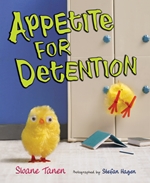
Appetite for Detention


Appetite for Detention, by Sloane Tanen & Stefan Hagen

From back-to-school anxiety and chick cliques to gym class, teachers, and other eye-rolling icons of school life, these photographic scenes of the teen experience are as ingenious as they are hilarious. Specifically concerned with the trials and tribulations of high school and teendom, this book will have teens everywhere (and more than a few adults) laughing with recognition.

This is another of the chick picture books, although these are not bed-time stories, but instead pointed comments on the terribly small gap between children and adults, a la Uncle Shelby's ABZ Book. This particular volume concerns itself with the younger population, which is perhaps why it isn't my favorite - pictures of chicks getting a hot pink tan seem more effective, somehow, when it's about spoiled adults. There is also more of a linear story-line in AfD, in which eight chicks vie for popularity, love, and valid excuses for skipping phys ed. There are definitely some of the same winning lines that so endeared Bitter with Baggage Seeks Same to me (Sample from AfD: "Edgar wasn't a skater, a punk, a jock, a geek, or a nerd. He was just depressed, and he hadn't found that clique yet.") , but the pages were less packed with them. Still funny, but not the best of the bunch. See? I can resist the awful egg and chick puns when I really try. Even if I do die a little inside.

Wildwood Dancing


Wildwood Dancing, by Juliet Marillier

There are many mysteries within the wildwood. Jena and her sisters share the biggest of all, a fantastic secret that enables them to escape the confines of their everyday life in rural Transylvania. They have kept it hidden for nine long years.

When their father falls ill and must leave their forest home over the winter, Jena and her oldest sister Tati are left in charge. All goes well until a tragic accident allows their over bearing cousin Cezar to take control. The appearance of a mysterious young man in a black coat during their full moon revels divides sister from sister, and suddenly Jena finds herself fighting to save all she holds dear. With her constant companion Gogu by her side, she must venture to realms dark and perilous in her quest to preserve, not just those she loves, but her own independence as well.


The story is clearly a fairy tale, but one which Marillier has twisted beyond easy categorization. Jenica, the second eldest of five sisters, narrates the story, which is a good thing, because starting at about halfway through the book, I just wanted to slap her older sister, an urge which never really went away. This one was a bit of a slow starter for me - not one of the ones which grabbed me from the first chapter. On the contrary, the mass introduction of characters and names, both in Transylvania, and in the Other Kingdom put me off reading it, and only after about five chapters did I really settle into the story. This is obviously a take on the Twelve Dancing Princesses, although the initial premise is really all that they have in common. I enjoyed the building menace throughout the book, especially regarding the girls' cousin Cezar, who is kinda the archetypical domestic abuser.


Marillier is less adept at maintaining the mysteries of the book - the ending and several twists were broadcast far in advance, losing a lot of tension in terms of the "magical" problems that Jena deals with (as opposed to the "real" problems - i.e., her cousin's impending molestation and disinheritance of her, etc.). This was sort of inevitable, since the whole set up was a little intricate, and obviously required some notice before they explained it all away on the last page, but the intricacy of the premise combined with Jena's inability to decipher any the clues just gave me a headache. So rather than compelling me to solve the various parts of the mystery myself, I mostly just read in high dudgeon until it all got resolved.


To be fair, Jena does have a lot piled on her plate, and her oldest sister, as I mentioned earlier, is less than useless. Literally. There were some very lyrical parts of the book, but I never really felt swept away in either world - I didn't get a very good impression of the various attributes of each setting. However, in spite of the beginning, once Jena's story starts to take shape, the book becomes much more readable and enjoyable - it did give me a little bit of a warm fuzzy feeling, so I am not completely devoid of sympathy for true love after all.