Showing posts with label comics. Show all posts

Saturday, July 19, 2025

Family Style

Family Style

By Thien Pham

Thien's first memory isn't a sight or a sound. It's the sweetness of watermelon and the saltiness of fish. It's the taste of the foods he ate while adrift at sea as his family fled Vietnam.

After the Pham family arrives at a refugee camp in Thailand, they struggle to survive. Things don't get much easier once they resettle in California. And through each chapter of their lives, food takes on a new meaning. Strawberries come to signify struggle as Thien's mom and dad look for work. Potato chips are an indulgence that bring Thien so much joy that they become a necessity.

Behind every cut of steak and inside every croissant lies a story. And for Thien Pham, that story is about a search―for belonging, for happiness, for the American dream.

 I liked Family Style, although it suffers from the same problem that so many graphic novels do: it's so fast (and relatively easy to read) that it feels less substantial than it should.  For example, I'm pretty sure I read and liked The Best We Could Do, but it doesn't stick in the memory the way a longer, heftier tome would. Anyway, maybe writing this review will help. 

 I liked the framing device that Pham uses, of focusing on certain moments in his life and spotlighting them, along with the food that they're associated with, the early chapters involving his family's escape from Vietnam and subsequent stay in a refugee camp, then culture shock in the United States, integration, and finally citizenship.  For some reason the last section felt very disconnected from the earlier parts, and I'm not sure if it's because it seemed like the author skipped so much time or what. I did read the book over several days so I guess that may be partially to blame, but it still took me a really long time to figure out that we were still following the main character (i.e., the author) and hadn't switched to his father's point of view.  

But by far the best part was the commentary and Q&A section at the end. His conversations and interviews directly with his family members (and illustrated, to boot!) were hilarious. I love the Calvin & Hobbes 20th Anniversary book for the same reason: we frequently get commentary and annotations from actors and singers but less common is an author's commentary on their own book (aside from introductions) and even less often (but very fun) is a comic artist's commentary. 


25: A Book Where The Main Character Is An Immigrant Or Refugee


Saturday, May 3, 2025

Ballad for Sophie

Ballad for Sophie

By Filipe Melo and Juan Cavia

1933. In the small French village of Cressy-la-Valoise, a local piano contest brings together two brilliant young players: Julien Dubois, the privileged heir of a wealthy family, and François Samson, the janitor's son. One wins, one loses, and both are changed forever.

1997. In a huge mansion stained with cigarette smoke and memories, a bitter old man is shaken by the unexpected visit of an interviewer. Somewhere between reality and fantasy, Julien composes, like in a musical score, a complex and moving story about the cost of success, rivalry, redemption, and flying pianos.

When all is said and done, did anyone ever truly win? And is there any music left to play?

Had absolutely no idea this was a graphic novel when I chose it, but no regrets. It's a strikingly beautiful take of a talented pianist being interviewed as he slowly dies from cancer, and tells the story of his youth and rise to fame, including his competition with a supernaturally talented - but less fortunate - boy against whom the pianist is always measuring himself. 

The drawings are piquant and add the right touch of sharpness to a narrative which is frequently tragic although ultimately hopeful. It's extremely emotionally satisfying, as we get to review Julien's own past and actions through the interviewer's kinder, more distant lens. At one point, Julien refers to himself as the villain of his own story, but it's not nearly so straightforward as all that. The authors have done an incredible job making him multifaceted - both victim and perpetrator, winner and loser. The destruction of his childhood by forces beyond his control sets the stage for his unhappy life of fame.  Although playing is the only thing which seems to give his life purpose, it is only when he has irrevocably severed that link that we see Julien at peace.

Although Julien is obsessed with François as a literal rival, in the end, Julien's deeper struggles are against his own idealized vision of himself, and all the ways he sees his own failures and lapses. In all the book, there is never a point at which François speaks with Julien, and so we are left wondering what, in fact, François ever thought of Julien to begin with.  Would he have blamed Julien for the early derailment of his dreams? Did he know of all the ways that Julien's life intersected with his own? Is there a world in which they could have been friends? I know how I would answer those questions, but perhaps that says more about me than François.

In any case where an audio experience is described through a written medium, there's going to be some loss of translation. It's a testament to the authors here that a story ostensibly about music can be conveyed so well through the pages of Ballad for Sophie. In fact, one of the authors is a musician and composed music for the book, which though unnecessary, is a  There's no false notes (pun not intended). As I sit and recall the novel for this review, I find its impression is only improved in my memory.  I would recommend this book to any reader who appreciates art, in all its forms. 


31: A Book Where Music Plays An Integral Part Of The Storyline

Saturday, March 22, 2025

Double Header: Duck Duck Taco Truck & Mabuhay!

Duck Duck Taco Truck 

By Laura Levoie and Teresa Martinez

"Duck. Duck. Taco truck. Working hard to make a buck."

Two food trucks staffed by sworn enemies: ducks vs. geese. Before you can say "curly fries", these two rivals are in an epic food truck face-off. "Battle on! At dawn, we ride!"

But soon, Goose becomes overwhelmed by hangry crowds. He sure could use some extra wings to help out! Will these foes find a solution and become feathered friends?

This clever, high-energy, taco tale, packed with bright art featuring kids' favorite foods, shows young readers how cooperation and teamwork can overcome conflict. It's a superbly silly summer story, the perfect pick for taco and truck fans.

Mabuhay!

By Zachary Sterling

Can two kids save the world and work their family food truck?

First-generation Filipino siblings JJ and Althea struggle to belong at school. JJ wants to fit in with the crowd, while Althea wants to be accepted as she is. To make matters worse, they have to help their parents run the family food truck by dressing up as a dancing pig and passing out samples. Ugh! And their mom is always pointing out lessons from Filipino folklore -- annoying tales they've heard again and again. But when witches, ogres, and other creatures from those same stories threaten their family, JJ and Althea realize that the folklore may be more real that they'd suspected. Can they embrace who they really are and save their family?

It seemed a little skimpy to use one illustrated kid's book as a prompt, so instead I used two! Duck Duck Taco Truck is a picture book for the 2-4 crowd, which is who I read it to. It wasn't an instant hit there, but I enjoyed it at least.

For me, the key to enjoying reading kids books for toddlers is that they need to be at least a little bit smart. Good rhythm is important (one of my recent favorites to read is The Seven Silly Eaters), although rhyming isn't essential (we also enjoy a good Marianne Dubuc story), decent illustration and compelling story. It doesn't have to be complicated, and in fact that sometimes hurts the experience. Very little actually happens in the evergreen Blueberries for Sal, but what does happen is beautiful.

All that is to say, the unexpected resolution of Duck Duck Taco Truck charmed me. I thought for sure it would be a great battle in which the taco ducks emerge victorious over goose, but this was better, a little bit kinder, even if I think the revised food combos sounded grosser than the original offerings. It's not a perennial classic, but I won't mind reading it a few more times.

Mabuhay! is a graphic novel for older kids, maybe the 8-10 year olds. It's a good little book, even if (like Duck Duck Taco Truck) it doesn't meet the high standard of similar books (here I'm thinking of Vera Brosgol's oeuvre).

There's good elements in it, characters, setting and illustrations, but I do think the shift to a supernatural battle would have been better served if it had been a longer book. The coming of age story alone would be fine in something this size, but once the paranormal element was brought in, it felt like we just got sidelined character development in order to rush through the plot. The revelations the kids have in the third act feel less important in light of the battle for light over darkness. 

That's probably why all my favorite parts are in the first half: Tito Arvin is great whenever he appears, the video game all-nighter with JJ, Althea, and Victor is hilariously accurate, and the side stories about Juan Tamad and Pinya are fun digressions. But having Juan be the one to tell JJ that being yourself is best feels like trying to fit a square peg into a round hole. Like it was shoehorned in because someone needed to do it and otherwise there was no point to Juan. There also didn't seem to be any rhyme or reason for the magical powers that JJ and Althea developed: why did the unathletic kid get martial arts weapons?

Of course, the book doesn't stint on the most important part (especially a book about food trucks): descriptions of food, including a recipe for chicken adobo in the back. That would have been real cause for complaint. Mabuhay!
 
29: A Book About A Food Truck

Saturday, February 22, 2025

The Terrible and Wonderful Reasons Why I Run Long Distances

The Terrible and Wonderful Reasons Why I Run Long Distances

By The Oatmeal (Matthew Inman)

This is not just a book about running. It's a book about cupcakes. It's a book about suffering.
It's a book about gluttony, vanity, bliss, electrical storms, ranch dressing, and Godzilla. It's a book about all the terrible and wonderful reasons we wake up each day and propel our bodies through rain, shine, heaven, and hell. 
From #1 New York Times best-selling author, Matthew Inman, AKA The Oatmeal, comes this hilarious, beautiful, poignant collection of comics and stories about running, eating, and one cartoonist's reasons for jogging across mountains until his toenails fall off.

This one was kind of a gimme, as it's not technically about a running club, but it is very much (except for the digression on Japanese murder hornets) about running. And I picked it up as I've started running again as well and thought it might be helpful, humorous, or thought provoking. Unfortunately, I don't think I would say it's any of those three, but it was easy enough to read and inoffensive.

I'd read, and reasonably enjoyed, the book he did on Why My Cat is More Impressive Than Your Baby, but this one wasn't nearly as amusing, probably intentionally. It ends up reading more like illustrated diary entries than comics. The best part is the story about the vending machine and the hornets, but there's no punchline, just an attempt to make sense of the force that drives us to run, and that's just not what I want from The Oatmeal. 

The good news is that it was very short and easy to read, so it's not like it was a waste of time. And fwiw, people I know who love his work were also chortling at this one too, so I think we'll just chalk this up to the wrong book at the wrong time.
 
17: A Book About A Run Club

Friday, May 28, 2021

Ten Second Reviews

Storybook Style: America's Whimsical Homes of the Twenties

By Arrol Gellner

Storybook Style, the rambunctious evocation of medieval Europe in American housing, was born in the early 1920s and almost forgotten by the late 1930s. It took its inspiration from the Hollywood sets that enthralled Americans of the period and that still appeal to our jaded modern eye. Half timbered and turreted, pinnacled and portcullised, these houses owed their fanciful bravura to architects and builders with theatrical flair, fine craftsmanship, and humor. In Storybook Style, architectural information enhances the stunning color pictures by Bungalow and Painted Ladies photographer Doug Keister to impart a wealth of information and enjoyment.


So this was a little off the beaten path, in the sense that it's an architectural coffee table book but I checked it out because of an interview with the creator of McMansion Hell, which I enjoy perusing quite a bit.  I'd never heard of Storybook Style, but I was immediately charmed.  

The problem with Storybook Style is that it is both expensive to keep up and not well suited to mass production, so there aren't so many examples and pictures that I would have liked.  Don't get me wrong, there's like, eight chapters, but each of them spends a lot of time on just two or three houses, and in comparison with, for example, bungalow books, which are dense with historical information and pictures, this felt much more minimal.  I do like pictures the most though, since I'm not an architectural student, so I liked that the ratio of pictures to text was so high, I just wanted more and more pictures.  More fantastical creations!

That being said, Storybook houses are pretty great, and we should have more of them.  I think I may be able to convince my husband to convert our front door into a faux-medieval style one, and from then on it's just a slippery slope to mythical creature iron sconces, cobblestone paths and a hedge maze!


The Witch Boy

By Molly Ostertag

In thirteen-year-old Aster's family, all the girls are raised to be witches, while boys grow up to be shapeshifters. Anyone who dares cross those lines is exiled. Unfortunately for Aster, he still hasn't shifted ... and he's still fascinated by witchery, no matter how forbidden it might be. When a mysterious danger threatens the other boys, Aster knows he can help -- as a witch. It will take the encouragement of a new friend, the non-magical and non-conforming Charlie, to convince Aster to try practicing his skills. And it will require even more courage to save his family... and be truly himself.

I don't know why so many of my recent books have witches and wizards in the titles, although I do like a good fantasy!  This one, eh, not worth the time.  It's a graphic novel, and geared towards (I assume) younger readers, like middle-grade, given the style, characters, and plot.  

It felt pretty simplistic to me, that Aster wants to break out of the gender-specific roles he's been assigned, only to discover that he can help, if he uses his "women's" magic, and the bad guy turns out to be (SPOILER!) a similarly situated man who was denied the right to use women's magic and turned to the dark side as a result.  Nothing too ground-breaking, although I guess it's fine to re-hash older tropes in new formats for new readers.

Honestly? Fairly forgettable for me. 

Saturday, January 11, 2020

The Assassination of Brangwain Spurge

The Assassination of Brangwain Spurge

By M.T. Anderson and Eugene Yelchin


Uptight elfin historian Brangwain Spurge is on a mission: survive being catapulted across the mountains into goblin territory, deliver a priceless peace offering to their mysterious dark lord, and spy on the goblin kingdom — from which no elf has returned alive in more than a hundred years. Brangwain’s host, the goblin archivist Werfel, is delighted to show Brangwain around. They should be the best of friends, but a series of extraordinary double crosses, blunders, and cultural misunderstandings throws these two bumbling scholars into the middle of an international crisis that may spell death for them — and war for their nations. Witty mixed media illustrations show Brangwain’s furtive missives back to the elf kingdom, while Werfel’s determinedly unbiased narrative tells an entirely different story.

Soooooo, okay, I really wanted to like this more, and I should have, but I couldn't enjoy it much because Brangwain Spurge was such a DICK.  I spent most of it wanting him to fall into a deep crevasse and die, while simultaneously being very fretful about Werfel's house, job, life, and his pet, because no one seemed to care about Werfel.  And his pet icthyod.  BEKKY!!!!!! Her getting smacked around is a direct result of Spurge's assholery and I for one do not forgive him.

Anyway, it's a very clever and well executed idea, that we're getting two different stories, from the goblin perspective and the elfin perspective (and for those of us who are kind of thick, like me, both the comments about Spurge's pictures not matching their actual appearances at all plus finally getting to see Werfel at the end made it very clear that Spurge is a liar and a FUCKTARD).  As clever as it was though, it was actually pretty depressing too, the way that everybody seemed bound and determined to go to war, although it sounded like that was mostly on the elf king's side of things, since most of the goblins were pretty nice to Spurge until his true colors showed through.

What a rude fucking houseguest.

Anyway, I also realized upon finishing that the author, M.T. Anderson, was also responsible for one of the most horrifying deaths and autopsies in "young adult" fiction (The Astonishing Life of Octavian Nothing: Traitor to the Nation), such that, despite being an otherwise excellent book, I have been unable to bring myself to re-read it so that I can finally read the sequel.  Given these products, I'm a bit worried about the inside of Anderson's head - it seems like it might be a most distressing place.

Anywhoodle, I'm glad that Werfel and Spurge are buddies now, but I haven't forgotten that Werfel's house was firebombed because of Spurge, and I do not forgive him.  Not to mention, now that both leaders and a ton of people got killed in the end, both countries are incredibly unstable right now, and I am very concerned about future wars. 

Monday, December 30, 2019

Ten Second Reviews

Cut to the Quick

By Kate Ross

Julian Kestrel is the walking definition of a Regency-era dandy. He cares about little beyond the perfection of his tailoring, he lives for the bon mot, and his life has the specific gravity and the fleeting charm of a soap-bubble. At least that's what he'd like you to think. In fact, it rather suits Kestrel to be perpetually underestimated, particularly when as in this instance his weekend at a glamorous country estate is spoiled by a dead girl's body being found in his bed.
I did like this one - it was a nice break from modern day thrillers, which can be so overwrought.  This one is much more of a classic mystery, with interrogations and secrets discovered, although there is still the confrontation of the murderer, here, it's with the guise of an actual magistrate's duty.  It feels like a pretty chunky book - there's a lot to the back story, which comes out in pieces (and more than a few coincidences, but they aren't the most egregious), so it took me a while to get through it.  Overall, I enjoyed the Regency setting, and the characters, enough to look into the sequel.  Onward and upward!


Comics for a Strange World: A Book of Poorly Drawn Lines

By Reza Farazmand


This follow up in the Poorly Drawn Lines series was not nearly as good as the first, for some reason.  Possibly because it felt like it focused more on robots and technology than absurdist humor.  So-so, but I would get the first book and skip this one.


A is for Arsenic: The Poisons of Agatha Christie

By Kathryn Harkup


This is an alphabetically arranged examination of the poisons used in Agatha Christie's books (funny: you'd never know it from the title).  I really liked this one - first of all, I never realized that Christie was a chemist, and that she kept her poison use really factual and close to reality.  Maybe this is a little embarrassing, but I barely noticed the actual murder weapon when I was reading  - it almost felt superfluous sometimes, since motive seemed so much more important (and Christie always made sure multiple suspects would have been capable of the means).  Harkup goes into detail not only in how Christie used the poison in a particular book/story, but also into the poison itself, famous real life murders, effects on the body, etc.  I have just one complaint, which is that Harkup gets into the chemical properties of the poisons more than is really necessary for most laypeople (and geez, I hope all of her readers are laypeople and not budding young poisoners looking for tips) so I tended to skim the passages about enzymes and receptors and molecules.  But the rest is highly enjoyable, although I would recommend against reading it while sitting with a dying relative receiving morphine, because it will give you bad dreams.

Thursday, December 19, 2019

Ten Second Reviews

Poorly Drawn Lines

By Reza Farazmand

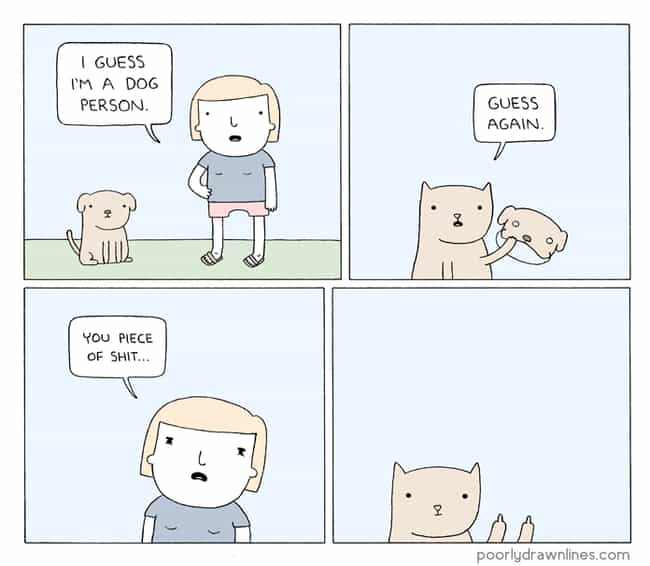
Dog Vs Cat People is listed (or ranked) 2 on the list 22 Poorly Drawn Comics With Surprisingly Hilarious Endings

This is a collection of short panel comics by Farazmand, who got his start online (and is still there, I assume).  These are mostly 4-6 panels apiece, with some longer ones mixed in.  They've got that off-the-wall humor which I enjoy, talking animals and inanimate objects, birds judging how well you sing, aliens who just want friendship bracelets, thirty-seven year-old babies with beards, weirdly tall frogs, robots who suck.  It's got a bit of that Far Side influence, but it feels a bit more Dada-esque (yeah, I know shit).  One thing I didn't like was the formatting - if you have a four-panel page, but a six panel comic, for the love of god, just make it smaller and put it on one page!  It makes it weirdly hard to figure out if the small panel is a continuation of the previous page or a new comic.  Same for the eight (or more) panel comics.  When stuff is online first, you don't have the same space restrictions you'd get if they were published in the newspaper.  So they're all different lengths.  But you gotta solve that problem when you publish - and I don't think they've quite cracked the code yet.  But overall, a fun diversion, and a good gift for someone with that absurd sense of humor.


Through The Woods

By Emily Carroll


This is sort of the antithesis to Poorly Drawn Lines: short stories instead of panels, arty illustrations instead of block characters, horror instead of comedy, confusing instead of straightforward.  I got this because I wanted some spooky stuff to read, and they were definitely - atmospheric - but I felt like a lot of them were kind of ended the same way: you have a set up with a spooky premise (I killed my brother but he's standing right there drinking, a lady is hearing a chilling song in the floorboards, my friend has a cloud thing that has arteries over her head, my mother warned me about the piano-teeth monster, etc), and then the character takes further action (goes down a hole to follow a monster [in several stories, actually, they should probably stop doing that], cracks open the walls and finds body parts, discovers someone is missing, etc) there's maybe like a little more explanation or clues about what's going on, but mostly not, and then we end with, like an ominous close up (of the monster, of the piano teeth, of the beating heart cloud, etc) but honestly, some of it (most of it) is so confusing, I can't figure out enough of what's going on to be scared.    For example, in the piano teeth one, Emily follows Rebecca down a hole and see her face come off into red worms, and then she leaves and hits her head and comes to back at the house, where she talks Rebecca out of using her body as a sack for Rebecca's red worm babies.  But then at the end, we find out Emily has piano teeth too.  So..... is she already a red worm monster? Did Rebecca change her mind and use her body anyway? It's so weirdly obtuse.  And the one where the brother is killed and then comes back, the narrator follows him down a hole he's been digging, and then sees... someone sleeping on the ground? The wolf the brother killed earlier? The brother is the wolf? Totally unclear. Anyway, beautifully illustrated, but a bit obtuse for me.   

Sunday, November 17, 2019

Be Prepared

Be Prepared

By Vera Brosgol

All Vera wants to do is fit in―but that’s not easy for a Russian girl in the suburbs. Her friends live in fancy houses and their parents can afford to send them to the best summer camps. Vera’s single mother can’t afford that sort of luxury, but there's one summer camp in her price range―Russian summer camp.

Vera is sure she's found the one place she can fit in, but camp is far from what she imagined. And nothing could prepare her for all the "cool girl" drama, endless Russian history lessons, and outhouses straight out of nightmares!
This is a middle-school readers semi-autobiographical graphic novel about nine year old Vera, who, finding herself not fitting in amongst her (non-Russian) schoolmates after a disastrous sleepover, begs her mom to send her and her brother to Russian scout camp - where she unhappily discovers that there's just never a guaranteed way of fitting in and making friends.

This was going to be a Ten Second Review but - as you'll notice - I got a little expressive and the review got a little lengthy.

I really loved this book. It's beautifully illustrated, with muted colors and expressive faces, but more than that, it really gets to the heart of a common pre-teen girl (and boy) experience: beginning to compare yourself and your family to others and feeling awkward or embarrassed or just plain uncool.

I remember myself the pain of having to leave a slumber party early (god, ALL the slumber party shit.  Why do I still love the idea of slumber parties when all of my memories are of like, extreme embarrassment? WHAT PYJAMAS YOU WEAR DETERMINES YOUR SOCIAL STATUS FOR LIFE AND LET'S NOT EVEN TALK ABOUT THE DELICATE ART OF GIFT-GIVING), and the like, social minefield that is your pre-teens and early teens. Why no, I haven't been scarred at all by events that happened decades ago and I definitely don't still remember the excruciating details of another twelve year old making fun of me (with what is, in retrospect, not even good sarcasm).

And I - OH MY GOD I just remembered how much I hated bringing my sleeping bag  - which was flannel and super bulky and had to be wrapped up with elastics tied together because they had worn out and snapped - when my friend had, like, the speedo of sleeping bags - shiny, tiny, with its own cover bag to stuff it into. It was teal and hi-tech and shaped like a coffin, not a rectangle (remember that I don't make the rules about what is cool, I just know that coffin shaped sleeping bags are cooler than rectangles, or at least they were back in the mid-90s) and so fucking cool and everything my sleeping bag wasn't and I bet you my friend had not one clue that I was dying inside about her sleeping bag. She's happily married now with a really cute baby girl who slept on me for like an hour during dinner once, which was amazing and I highly recommend, and I really hope I have enough willpower not to message her and be like, "REMEMBER YOUR SLEEPING BAG FROM TWENTY YEARS AGO? I think I'm finally working out my feelings about it!"

I'm going to move on from my own traumas for like, one hot second, to reiterate that Be Prepared makes me want to, like, go back and relive my youth except now, I would be able to unclench and actually enjoy it more, having learned the hard lesson that is growing up and becoming (and loving) your own self.  Be Prepared achieves the hard balance of getting to the heart of these seemingly insurmountable embarrassments and cruelties (which are in hindsight pretty minor) without actually wallowing in it or becoming too schadenfreude-y.  This is not cringe-kink (ew, gross, I hate this word I just made up and will never use it again). 


I will definitely be reading more from Brosgol (I already have Anya's Ghost waiting for me at the library), and if you want to relive your youth, without actually, you know, reliving it, please pick this book up.  

Ironically, the girl whose slumber party I left early now leads hiking expeditions into the wilderness for young women. What a wonderful world.

Sunday, May 12, 2019

Comic Bonanza

Here's a round-up of a couple of kid-friendly(ish) comic books I've been reading:

Courtney Crumrin, Vol. 1: Courtney Crumrin & The Night Things

By Ted Naifeh

Courtney's parents have dragged her out to a high-to-do suburb to live with her creepy Great Uncle Aloysius in his spooky old house. She's not only the new kid in school, but she also discovers strange things lurking under her bed.
This one is why I'm calling these "kid-friendly (ish)" emphasis on the "ish".  Courtney is a somewhat darker take on the beginning witchcraft dabbler tale, both figuratively and literally.  I mean, everything is kid-appropriate, but at one point a changeling takes away a baby that Courtney is watching, and although she tries to get it back (being captured and sold herself) her uncle basically tells her in the end, "Forget about trying to get the baby back, these things happen, his parents won't even notice." And they don't!  That was a more chilling story than I expected it to be.  Anyway, these are set up as four short stories, all in black and white.  I would have loved to have them in color, but I suppose it sets the mood.  Courtney herself is an entertaining little curmudgeon.  The last story finds her losing energy, only to realize she's been replaced by a doppelganger who is living her life (and doing much better at it apparently).  In the final confrontation, you think that Courtney will let the doppelganger just take over since everyone seems to prefer it to her, but she comes out swinging hard with a "fuck everyone else, I'm a difficult and unpleasant person, and that's exactly how I want to be!" that completely saps the doppelganger.  Good on you, Courtney.  I would never want to meet you in real life, but bless your confidence. 

Goldie Vance Vol. 1

By Hope Larson and Brittney Williams

Sixteen-year-old Marigold “Goldie” Vance lives at a Florida resort with her dad, who manages the place. Her mom, who divorced her dad years ago, works as a live mermaid at a club downtown. Goldie has an insatiable curiosity, which explains her dream to one day become the hotel’s in-house detective. When Charles, the current detective, encounters a case he can’t crack, he agrees to mentor Goldie in exchange for her help solving the mystery.
This one is a lot of fun to read, colorful, bouncy, basically Nancy Drew in 60s Florida, if Nancy weren't so lily white.   Whereas Courtney was a loner and preferred it that way, Goldie has a colorful cast of supporting characters, including friends, enemies, potential ladyfriends, adults who seem to exist mainly for spoiling fun, and also: aliens!  Yes, I was really getting into the story when it took an abrupt right turn into Martian colony weirdness.  This was set up so the mini-stories merged into a longer connected story, so we'll have to see if all of the mysteries end like that.  It was a little off-putting, but I (a) enjoyed the rest of it enough to keep reading and (b) can kind of see where they're going with the 60s cold war and space-focus (one of Goldie's friends wants to be an astronaut) so I will allow it for now.

The Lost Path

By Amélie Fléchais

Three young boys set off from Camp Happiness, map in hand, determined to be the first to find the treasure before anyone else. But the shortcut they take leads to something far more spectacular and sinister! All manner of magical beasties live in these woods, and the kids find themselves caught between warring Forest Spirits. Will the three boys find their way out of trouble? Get your map and ready, set, go!
This was something I picked up and bought during my sojourn on Free Comic Book Day solely because of how beautiful it was, and that definitely panned out.  It is gorgeous, done in multiple color and drawing styles.  I would have liked something 100% in color, just because the coloring that was there was so beautiful, but, I acknowledge that (like Courtney) the black and white was an appropriate style choice for those sections - when the three boys are simply wandering in the woods.   I agree with a lot of other reviewers that felt the story-line was lacking in comparison to the illustration.  The story is good, but it felt oddly incomplete and only half explained.  We wind up in the middle of fighting forest spirits, but it was hard to tell who was on what side and why.  A crown/hat becomes a Chekov's Gun that never goes off, and when I got done, I went to look if this was intended to be a stand-alone story or not.  So far it is, which is a let-down.  Overall, a beautiful, but otherwise somewhat empty, little book.